
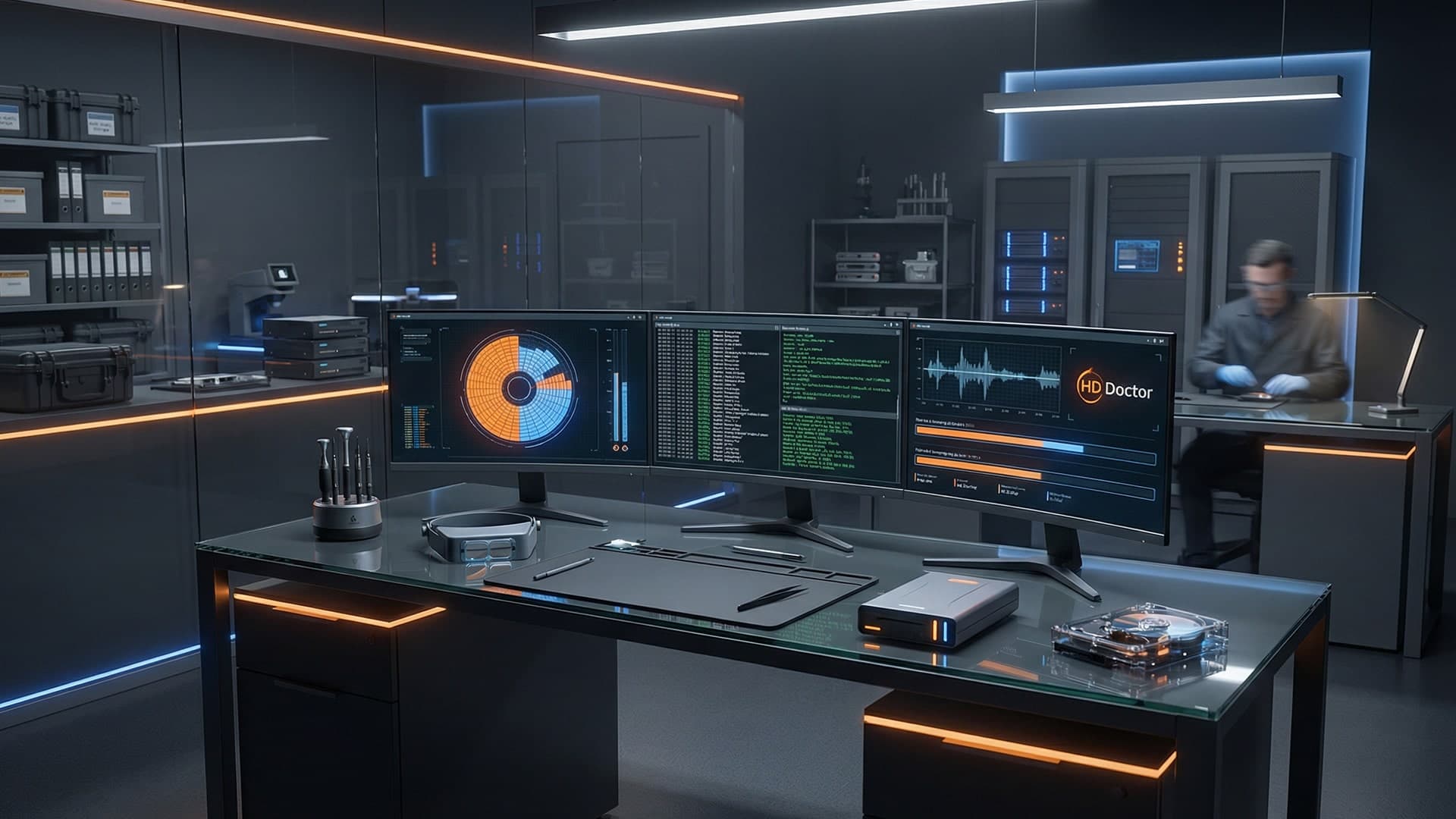
RAID 5 Data Recovery: When the Rebuild Fails
Direct answer
Yes, we recover RAID 5 even in scenarios of double disk failure, aborted rebuild, burned controller or corrupted firmware. With 24+ years and 4,300+ RAID 5 arrays solved with 96% success rate. We never run rebuild on the original array: we clone each drive bit-by-bit in isolated environment and virtually rebuild in lab, with zero overwrite risk.
Critical: if you see degraded, failed, inconsistent or rebuild failed on the controller, do NOT force rebuild, do NOT swap drives without cloning first, do NOT run mdadm --create, do NOT reformat the partition. Each of these actions can make recovery impossible. Power down the server and call us.
How RAID 5 works and why it fails
RAID 5 distributes data in stripes across 3 or more drives, with rotating parity tolerating 1 failure. When a drive dies, the array enters degraded state and parity rebuilds missing blocks in real time, but with reduced performance and maximum stress on surviving drives. If a second drive fails during rebuild (URE, unrecoverable read error scenario), the array becomes inconsistent and recovery via common software becomes impossible.
Common RAID 5 failure scenarios
| Cause | % | Recoverable? |
|---|---|---|
| Double disk failure during rebuild | 30% | ✅ Yes, virtual rebuild with parity |
| Rebuild aborted by bad blocks | 20% | ✅ Yes, aggressive clone + parity |
| Controller burned or swapped | 15% | ✅ Yes, direct SATA read + rebuild |
| Unknown stripe size | 10% | ✅ Yes, data pattern analysis |
| Multiple drives with growing bad blocks | 10% | ✅ Yes, custom retry policy |
| Mechanical failure on 1 or 2 drives | 10% | ✅ Yes, cleanroom + cloning |
| Forced array initialization with wrong config | 5% | 🟡 Partial, depending on overwrites |
Source: HD Doctor internal stats on 4,300 RAID 5 cases between 2022 and 2025.
What NOT to do with a failed RAID 5
- 1.Do not force rebuild with 2 drives off. Some controllers allow forcing rebuild ignoring inconsistencies, writing incorrect parity over still-recoverable data.
- 2.Do not run mdadm --create on Linux. That command initializes RAID metadata, overwriting the original config we'd need for reconstruction.
- 3.Do not swap drives without documenting original position. Drive order in the array is critical. Label each by original bay/slot before removal.
- 4.Do not run chkdsk / fsck on the degraded array. Rewrites file structures based on parity calculated incorrectly in degraded state.
- 5.Do not swap the controller without config dump. Different firmwares write metadata in different locations. Swapping without backup may lose the config.
How HD Doctor recovers RAID 5
We work exclusively on bit-by-bit clones. The virtual array is rebuilt in professional software, validated against known file structures.
- 1
Intake and drive identification
We document original bay/slot, serial and model of each array drive.
- 2
Individual diagnosis within 24h
SMART, mechanical and electronic evaluation of each drive. Identify which failed and at what stage.
- 3
Free written quote with scope
Technical analysis and recovery rate estimate before approval.
- 4
Bit-by-bit cloning of ALL drives
PC-3000 with custom retry policy, including apparently healthy drives (silent bad blocks are common cause of rebuild failure).
- 5
Physical repair when needed
Class 100 cleanroom for mechanical cases, PCB repair with ROM migration for electronic cases.
- 6
Array configuration analysis
Identify stripe size, parity (left/right symmetric or asymmetric) and drive order via data pattern analysis if config was lost.
- 7
Virtual RAID 5 rebuild
Professional software applies parity over copies to reconstruct dead-drive blocks. Zero writes to original array.
- 8
File validation
You receive the file tree to verify before payment. Each file classified: complete, partial or non-recoverable.
- 9
Delivery + final report
Copy to new media with checksum, signed engineer report.
Turnaround and SLA
| Scenario | Turnaround |
|---|---|
| 1 drive off, no physical damage | 5–10 business days |
| Double disk failure (rebuild fail) | 10–18 business days |
| Mechanical failure on a drive | 15–25 business days |
| Controller swapped / config lost | +5–7 business days for analysis |
- Express available for critical corporate cases with lab priority.
- No Data, No Charge policy: if we can't recover the critical files you flagged, you don't pay for the service. Diagnosis is free in 92% of cases.
Controllers and systems supported
We service every enterprise controller: Dell PERC (H310, H700, H730, H740, H750, H840, H965i), HP/HPE Smart Array (P410, P420, P440, P441, P840, MR416i), LSI MegaRAID (9260, 9271, 9361, 9460), Adaptec, Areca, Intel RST/RSTe, IBM ServeRAID, Promise SuperTrak, Highpoint RocketRAID. File systems: NTFS, ReFS, EXT3/4, XFS, BTRFS, ZFS, VMFS (3, 5, 6), HFS+, APFS.
Why HD Doctor for RAID 5
- 🏛️24+ years focused exclusively on data recovery
- 🔬In-house Class 100 cleanroom for mechanical cases
- 🧠Virtual rebuild: parity applied over clones, zero writes to original array
- 🤝Only Western Digital Platinum Partner with a regional lab in Latin America
- 📦Donor inventory with 6,000+ HDD models for head replacement
- ⚖️Signed engineer report legally valid for forensics and insurance
RAID 5 FAQ
My RAID 5 entered rebuild and aborted. Any chance?
Yes, in 90% of cases. Aborted rebuild usually means bad blocks on the apparently good drive causing URE during read. Aggressive lab cloning overcomes bad blocks in most critical areas. In post-forced-rebuild cases, we still recover in 67%.
Double disk failure: 2 drives off at the same time. Recoverable?
Yes. In RAID 5 with double disk failure, parity is no longer enough to rebuild blocks automatically, but if we can clone the 2 failed drives, we can virtually rebuild. In 96% of cases handled, we recover.
Controller swapped and I lost the config. Can you reconstruct?
Yes. We infer stripe size, rotating parity (left/right symmetric or asymmetric) and drive order via data pattern analysis and known structures (NTFS MBR, EXT4 superblocks, VMFS headers).
How long does it take?
Logical cases: 5 to 10 business days. Double disk failure: 10 to 18 business days. Mechanical cleanroom cases: 15 to 25 business days. Express available for corporate urgency.
Do you serve corporate servers with emergency SLA?
Yes. We service Dell PowerEdge, HP ProLiant, Lenovo ThinkSystem, Supermicro with emergency SLA and technical report valid for forensics, insurance and administrative process.
How does the quote work?
Diagnosis is free. After technical assessment within 24h we send a detailed quote by email or WhatsApp with root cause, estimated turnaround and scope.